The Ultimate Guide to Mastering Facebook Ads for Lead Generation
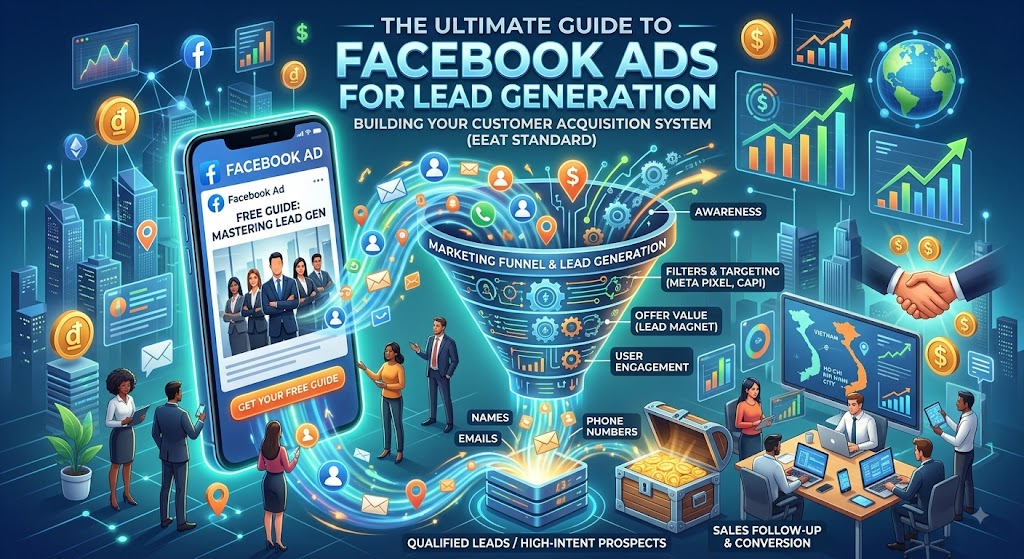
In today's hyper-competitive digital landscape, capturing high-quality leads is the lifeblood of any growing business. Whether you are a B2B software company, a local real estate agent, or an eCommerce brand, you need a predictable, scalable system for acquiring new prospects. Enter Facebook ads for lead generation.
Despite the rise of new social platforms and changing privacy regulations, Meta (Facebook and Instagram) remains an undisputed powerhouse for digital marketers. With nearly 3 billion monthly active users and highly sophisticated algorithmic targeting, leveraging Facebook ads for lead generation is one of the most effective ways to fill your sales funnel.
In this comprehensive guide, we will break down exactly how to build, execute, and optimize a lead generation strategy on Facebook. We will cover the technical setup, creative best practices, and expert strategies to ensure you attract high-intent prospects while keeping your Cost Per Lead (CPL) profitable.
What Are Facebook Ads for Lead Generation?
When we talk about Facebook ads for lead generation, we are referring to specific advertising campaigns designed to collect contact information—such as names, email addresses, phone numbers, and job titles—from users who express interest in your product or service.
Unlike brand awareness campaigns that simply want to get eyeballs on a logo, or direct-response eCommerce ads aiming for an immediate sale, lead generation ads serve as the crucial middle-of-the-funnel bridge. You offer the user something of value (a lead magnet, a quote, a consultation), and in exchange, they give you permission to contact them.
Meta offers a few different ways to execute this, but the two most prominent methods are:
- Native Lead Ads (Instant Forms): Users click the ad, and a form pops up directly inside the Facebook or Instagram app, often pre-filled with their profile data.
- Conversion Campaigns: Users click the ad and are directed to an external landing page on your website where they fill out a form.
Why Use Facebook Ads for Lead Generation?
If you are wondering whether investing in Facebook is still worth it, the data and industry experience resoundingly say "yes." Here is why this platform is essential for your lead-gen efforts.
1. Unmatched Audience Targeting
Meta’s algorithm is incredibly adept at finding the right people. You can target users based on basic demographics, specific interests, behaviors, and even life events (like recently moving or getting engaged). More importantly, through the Meta Pixel and Conversions API, the algorithm learns who is converting and actively seeks out similar users.
2. Lower Friction with Native Forms
One of the biggest hurdles in lead generation is a clunky user experience. If a user clicks an ad on their phone, waits for a slow website to load, and then has to pinch-and-zoom to type in their email, they will bounce. Facebook’s native Instant Forms eliminate this friction. The form loads instantly within the app and auto-fills their contact information, skyrocketing conversion rates.
3. Scalable Lookalike Audiences
Once you have a list of high-quality leads or paying customers, you can upload that list to Facebook to create a "Lookalike Audience." Facebook will analyze the data points of your best customers and find millions of other users who share those exact traits.
4. Advanced Retargeting Capabilities
Not everyone is ready to hand over their email address the first time they see your brand. Facebook allows you to retarget users who have engaged with your page, watched a percentage of your videos, or visited specific pages on your website but didn't convert.
Native Lead Ads vs. Landing Page Conversions: Which is Better?
When setting up Facebook ads for lead generation, marketers often debate whether to use native Instant Forms or send traffic to a dedicated landing page. Both have distinct advantages and drawbacks.
See More: The Ultimate Guide to Scaling Your Store with a Dropshipping Facebook Ads Service
See More: The Ultimate Guide to Ecommerce Facebook Ads Management: Scaling Your Store and Maximizing ROAS
See More: The Ultimate Guide to Finding an Affordable Facebook Ads Agency
Here is a quick comparison to help you choose:
| Feature | Native Lead Ads (Instant Forms) | Conversion Ads (External Landing Page) |
|---|---|---|
| User Friction | Very Low (Auto-fills data, stays in app) | High (Requires site load and manual entry) |
| Lead Volume | Generally High | Generally Lower |
| Cost Per Lead (CPL) | Usually Cheaper | Usually More Expensive |
| Lead Intent/Quality | Can be lower (too easy to submit) | Usually much higher (user took the time to read and fill it out) |
| Customization | Limited to Facebook's form builder | Infinite (Your own website, branding, and copy) |
| Best For... | Top-of-funnel offers, newsletters, simple quotes | High-ticket B2B, complex services, webinars |
Expert Advice: If your sales team is struggling with low-quality leads who "don't remember filling out a form," switch to Landing Page conversions or add "Higher Intent" friction to your native Lead Ads (e.g., asking a custom multiple-choice question that cannot be auto-filled).
The 6-Step Guide to Setting Up High-Converting Lead Gen Ads
Ready to launch? Follow this step-by-step framework to build campaigns that actually convert.
Step 1: Craft an Irresistible Lead Magnet
Before you even open the Facebook Ads Manager, you need a compelling reason for someone to give you their information. People fiercely guard their inboxes today. You must offer extreme value.
Examples of High-Converting Lead Magnets:
- B2B: Industry reports, templates, swipe files, free audits, or webinar registrations.
- B2C/eCommerce: Exclusive discount codes (e.g., "Get 15% off your first order"), free samples, or giveaway entries.
- Local Services: Free estimates, buyer’s guides (e.g., "The 2026 Homebuyer's Guide to Ho Chi Minh City"), or complimentary consultations.
Step 2: Configure Your Campaign Objective
Go to your Meta Ads Manager and click "Create." You will be presented with a list of campaign objectives.
- Select Leads.
- At the Ad Set level, you will choose how you want to collect these leads: Instant Forms, Messenger, Calls, or Website (if you are using a landing page).
Step 3: Define Your Audience and Budget
Avoid the mistake of hyper-targeting right out of the gate. Meta’s machine learning is smarter than our manual targeting assumptions.
- Broad Targeting: Start with broad demographics (Age, Location, Gender) and let the algorithm do the heavy lifting based on your ad copy and creative.
- Detailed Targeting: Add 1-2 broad interests related to your niche to guide the algorithm.
- Custom Audiences: Retarget website visitors or people who have engaged with your Facebook/Instagram profiles in the last 30-90 days.
- Budget: Ensure your daily budget is high enough to exit the "Learning Phase." Meta needs about 50 conversion events per week to optimize effectively.
Step 4: Design Scroll-Stopping Creatives
Your ad creative (the image or video) is responsible for stopping the user from scrolling. Your copy (the text) is responsible for convincing them to click.
- Visuals: Use high-contrast images or native-looking user-generated content (UGC) videos. Videos where a founder or customer speaks directly to the camera often perform best for lead gen.
- The Hook: Address the user's pain point in the very first sentence. (e.g., “Tired of spending thousands on ads with zero ROI?”)
- The Value Proposition: Clearly state what they get by clicking.
- Call to Action (CTA): Be explicit. Use buttons like "Download," "Learn More," or "Sign Up."
Step 5: Build the Lead Form (For Native Ads)
If you chose Instant Forms, you will build it at the Ad level.
- Form Type: Choose "More Volume" (quickest) or "Higher Intent" (adds a review step so users can confirm their info).
- Intro: Use a clear headline and a brief bulleted list reminding them what they are getting.
- Questions: Keep it minimal. Name and Email are standard. If you need phone numbers, ask for them, but know it will increase your CPL. Pro-tip: Add one custom question (e.g., "What is your biggest marketing challenge right now?") to filter out bots and low-intent users.
- Privacy Policy: You must link to the privacy policy on your website.
Step 6: Automate the Follow-Up (Crucial Step)
A lead is practically worthless if you do not follow up immediately. The "speed to lead" metric dictates that your chances of qualifying a lead drop exponentially after the first 5 minutes.
Do not manually download CSV files from Facebook. Use a tool like Zapier or Make to connect your Facebook Lead Ads directly to your CRM (like HubSpot, Salesforce, or ActiveCampaign) and your email marketing software. Set up an automated sequence that instantly emails them the lead magnet and triggers a notification for your sales team to call them.
Expert Best Practices to Maximize Lead Quality and ROI
Generating leads is easy; generating profitable leads takes expertise. Here are advanced strategies to elevate your Facebook ads for lead generation.
1. Implement Conversions API (CAPI)
Relying solely on the browser-based Meta Pixel is no longer sufficient due to ad blockers and Apple’s iOS 14+ privacy updates. Setting up the Conversions API ensures server-to-server tracking, meaning when a lead comes in, your server communicates directly with Meta’s server. This drastically improves the algorithm's ability to optimize for the right people.
2. A/B Test Your Creatives Ruthlessly
Never rely on a single ad. Create a dynamic creative test where you test:
- 3 different visual hooks (e.g., 2 videos, 1 graphic)
- 2 different primary texts (long-form vs. short-form copy)
- 2 different headlines
Let the algorithm find the winning combination, then scale the budget on the winner.
3. Use Conditional Logic in Instant Forms
Meta now allows conditional logic in lead forms. This means the next question a user sees depends on their previous answer. If a user says their budget is "Under $1,000," you can route them to a polite "Thank you" page. If they say "Over $10,000," you can route them directly to a calendar booking link. This saves your sales team countless hours.
4. Optimize for "Conversion Leads" Instead of Just "Leads"
If you have a CRM integrated with Facebook, you can utilize the "Conversion Leads" optimization goal. Instead of Facebook just finding people who will fill out the form (Lead), it will look at your CRM data to find people who actually end up buying or moving down the pipeline (Conversion Lead). This bridges the gap between marketing metrics and actual revenue.
Common Mistakes That Will Drain Your Ad Budget
Even experienced marketers can stumble. Watch out for these common pitfalls when running Facebook ads for lead generation:
- Bait and Switch Tactics: Do not promise a "free guide" and then force them to book a phone call to get it. Deliver exactly what you promised on the confirmation page, then gently invite them to take the next step.
- Asking Too Many Questions: Every extra field on a form decreases your conversion rate. If you don't absolutely need their company name or zip code right now, don't ask for it. You can gather that data later during the sales process.
- Ignoring Ad Fatigue: If your CPL suddenly spikes after a few weeks, your audience is likely experiencing ad fatigue. They have seen the same image too many times. You must refresh your creatives regularly.
- Neglecting the "Thank You" Screen: The final screen of the lead form is prime real estate. Don't just say "Thanks, we will be in touch." Add a button that says, "While you wait, click here to read our latest case study" or "Click here to book your consultation now."
Conclusion
Mastering Facebook ads for lead generation is not about hacking the algorithm; it is about combining human psychology with technical execution. By offering genuine value through an irresistible lead magnet, removing friction from the user experience, and setting up bulletproof backend automation, you can turn Meta into a highly predictable revenue engine for your business.
Remember that success requires patience and testing. Your first campaign might not yield $1 leads, but by utilizing A/B testing, leveraging lookalike audiences, and continuously refining your follow-up process, your Cost Per Acquisition will steadily drop while your lead quality rises. Stop waiting for customers to find you—launch your first lead generation campaign today and take control of your pipeline.
Tags: Rent Facebook Agency Ad Account
Are you currently running Facebook campaigns but struggling with high Cost-Per-Lead (CPL), or are you starting entirely from scratch?
- Telegram: @AdsAgency_FB
- Email: [email protected]
- Address: 1500 N Grant St Ste B, Denver, CO 80203