The Ultimate Guide to Facebook Ads for SaaS: Strategies to Scale Your Software
When most marketers think about B2B customer acquisition, their minds immediately jump to LinkedIn or Google Search. For a long time, the prevailing myth in the software industry was that Facebook was strictly for business-to-consumer (B2C) marketing—a place to sell t-shirts, gadgets, and shoes, not enterprise software or productivity tools. However, that mindset is rapidly changing. Today, mastering Facebook ads for SaaS (Software as a Service) is one of the most powerful, cost-effective ways to fill your pipeline, drive free trial signups, and ultimately boost your Monthly Recurring Revenue (MRR).
Why? Because decision-makers, CEOs, and IT directors do not turn off their professional identities when they log into Facebook or Instagram on the weekends. They are scrolling through their feeds just like everyone else. If you can capture their attention with a compelling value proposition, Facebook’s algorithmic powerhouse can become your most scalable acquisition channel.
In this comprehensive guide, we will break down exactly how to build, launch, and optimize a highly profitable strategy using Facebook ads for SaaS companies. From structuring your marketing funnel to designing high-converting creatives and tracking the metrics that actually matter, you will learn everything you need to know to turn Mark Zuckerberg’s platform into a demo-generating machine.
Why Use Facebook Ads for SaaS?
Before diving into the technical setup, it is crucial to understand why investing in Facebook ads for SaaS is a strategic imperative in today’s competitive software landscape.
1. Unmatched Audience Scale and Sophistication
With billions of active users across Facebook, Instagram, Messenger, and the Audience Network, Meta possesses an unprecedented amount of data on user behavior. The algorithm knows what software tools people are interested in, what business publications they read, and what problems they are trying to solve. This allows SaaS marketers to tap into incredibly niche audiences that are otherwise difficult to reach.
2. Lower Cost Per Acquisition (CPA)
LinkedIn is undeniably the king of B2B targeting, but it comes at a premium. The Cost Per Click (CPC) on LinkedIn can easily range from $8 to $15 or more. In contrast, Facebook ads for SaaS typically yield significantly lower CPCs and CPMs (Cost Per Mille). By pairing Facebook's lower ad costs with a strong, multi-touch funnel, SaaS companies can achieve a much lower Customer Acquisition Cost (CAC) compared to other social platforms.
3. Advanced Retargeting Capabilities
The average SaaS buying cycle is not instantaneous. A user might visit your landing page, read a blog post, check out your pricing, and leave to consult their team. Facebook excels at keeping your brand top-of-mind. Through advanced pixel tracking and custom audiences, you can serve highly specific ads to users based on the exact actions they took on your website—such as pushing a demo ad to someone who visited your pricing page but didn't convert.
Facebook Ads vs. LinkedIn Ads for SaaS
To give you a clearer picture of where Facebook fits into your strategy, here is a quick comparison of how it stacks up against LinkedIn:
| Feature | Facebook / Meta Ads | LinkedIn Ads |
|---|---|---|
| Primary Strength | Broad reach, lower CPC, advanced retargeting, algorithm efficiency. | Precise B2B targeting (Job Title, Company Size, Industry). |
| Average CPC | Low to Medium ($0.50 - $3.00) | High ($5.00 - $15.00+) |
| Best For | Retargeting, lead magnets, building brand awareness, SMB SaaS. | Enterprise SaaS, Account-Based Marketing (ABM), high-ticket software. |
| Ad Formats | Video, Image, Carousel, Reels, Stories. | Single Image, Carousel, InMail, Document Ads. |
| User Intent | Passive/Entertainment (Requires strong hook to disrupt scrolling). | Professional/Networking (Users are in a business mindset). |
Laying the Foundation: Tracking and Data
The success of Facebook ads for SaaS hinges entirely on the quality of data you feed back to the platform. Unlike e-commerce, where a purchase happens instantly, SaaS conversions (especially B2B) are complex. A user might sign up for a free trial today, but not become a paying customer for 14 or 30 days.
See More: Facebook Ads Learning Phase: Everything You Need to Know to Improve Campaign Performance in 2026
See More: Facebook Ads Not Spending? 15 Reasons Your Campaign Isn't Delivering (And How to Fix It)
1. The Meta Pixel and Conversions API (CAPI)
First, ensure the Meta Pixel is installed across your entire website and web application. However, because of modern browser privacy restrictions (like Apple's iOS 14 update), relying solely on the browser-based Pixel is no longer sufficient.
You must implement the Conversions API (CAPI). CAPI sends data directly from your server to Facebook's server, bypassing browser blockers. This ensures you accurately track when a user signs up for a trial, books a demo, or upgrades their subscription, allowing Facebook to optimize your campaigns effectively.
2. CRM Integration for Offline Conversions
For SaaS companies with a sales-led motion (where leads talk to an Account Executive before buying), tracking only "Leads" on Facebook is dangerous. The algorithm might find you thousands of cheap leads who never answer the phone.
To run effective Facebook ads for SaaS, you must integrate your CRM (like Salesforce, HubSpot, or Pipedrive) with Facebook. By feeding back "Offline Conversions"—such as "Demo Completed," "Opportunity Created," or "Closed Won"—you train the algorithm to find users who actually buy your software, not just users who fill out forms.
Structuring the SaaS Facebook Ad Funnel
A common mistake software companies make is running bottom-of-the-funnel (BOFU) ads—like "Book a Demo" or "Start Your 14-Day Free Trial"—to completely cold audiences. Software is an investment of time, money, and operational change. You have to build trust first.
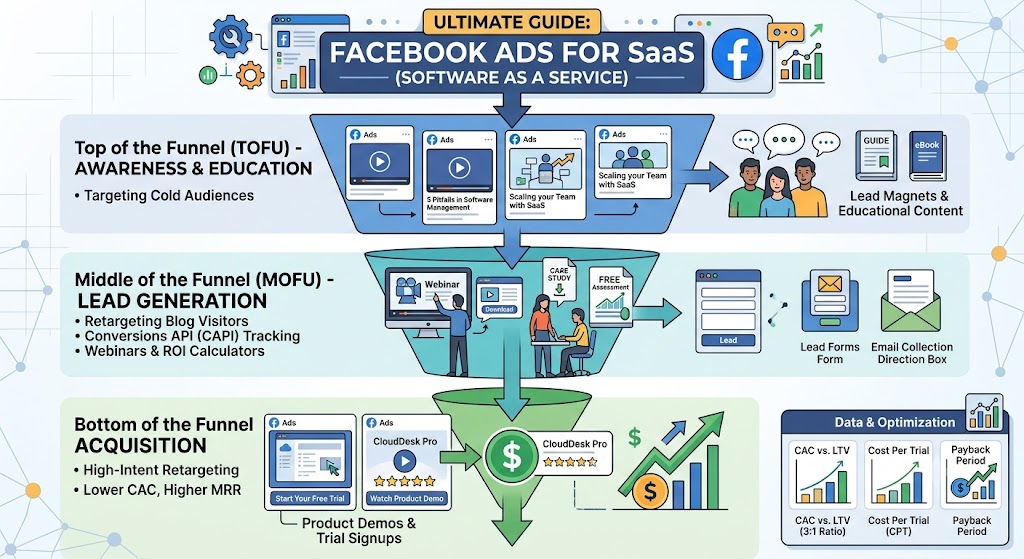
Here is how to structure a full-funnel strategy using Facebook ads for SaaS:
Top of the Funnel (TOFU): Awareness and Education
At this stage, your target audience might not even know they have a problem, let alone that your software is the solution. Your goal here is not to sell; it is to educate, provide value, and capture pixel data.
- Content Types: Educational blog posts, industry reports, ultimate guides, or high-level video content explaining a common industry pain point.
- Ad Formats: Video ads, single image ads, or carousel ads highlighting statistics.
- Targeting: Broad audiences, Interest-based targeting (e.g., targeting users interested in "Project Management" or competing software), and Lookalike audiences (1% to 3%) based on your current paying customers.
- Key Metric: Cost Per Click (CPC), Click-Through Rate (CTR), Video View Time.
Middle of the Funnel (MOFU): Lead Generation
Now that the user is aware of your brand and the problem you solve, it is time to capture their contact information. This is where you exchange high-value resources for their email address.
- Content Types: Webinars, whitepapers, templates (e.g., a free social media calendar template if you sell marketing software), or ROI calculators.
- Ad Formats: Facebook Lead Ads (native forms keep users on the platform and convert highly) or conversion campaigns pointing to a dedicated landing page.
- Targeting: Retargeting users who engaged with your TOFU content, visited your blog, or watched at least 25% of your TOFU videos.
- Key Metric: Cost Per Lead (CPL), Lead Quality.
Bottom of the Funnel (BOFU): Acquisition
The prospect knows who you are, understands their problem, and has consumed your educational content. Now it is time to make the hard pitch.
- Content Types: "Start Your Free Trial," "Book a Personalized Demo," "Get 50% Off Your First Month," or direct comparisons against competitors (e.g., "Why We Are Better Than [Competitor]").
- Ad Formats: Dynamic product ads (if applicable), compelling video testimonials, or static images featuring your software's UI.
- Targeting: High-intent retargeting. Target users who visited your pricing page, read specific feature pages, or attended your MOFU webinar.
- Key Metric: Cost Per Acquisition (CPA), Customer Acquisition Cost (CAC), Return on Ad Spend (ROAS).
Audience Targeting Strategies for SaaS
Finding the right audience is the linchpin of running profitable Facebook ads for SaaS. Here are the most effective targeting strategies to deploy:
Value-Based Lookalike Audiences
Do not just create a lookalike audience of your email list; not all users are created equal. Some are free-tier users, while others are high-paying enterprise clients. Export a list of your highest Lifetime Value (LTV) customers from your CRM and upload it to Facebook. Ask Facebook to create a 1% Lookalike audience based on this specific group. The algorithm will find users who share the demographic and behavioral traits of your best, most profitable customers.
Competitor Interest Targeting
While Facebook does not always let you target your competitors by name (unless they are massive companies like Mailchimp or Salesforce), you can often target the broader ecosystem. If you are a new CRM SaaS, target users who are interested in HubSpot, Salesforce, or Zoho. You can also target publications your ideal customer reads, such as Harvard Business Review, TechCrunch, or Forbes.
Event and Webinar Retargeting
If your SaaS company attends trade shows or hosts webinars, use these events as targeting parameters. You can upload the attendee lists as Custom Audiences and serve them ads following up on the event. For example: "Great seeing you at SaaStr Annual! Ready to see how we can automate your workflow? Book a demo today."
Mastering B2B SaaS Ad Creatives
In the world of Facebook ads for SaaS, the creative is the ultimate variable. The algorithm is smart enough to find your buyers, but your ad must be interesting enough to stop them from scrolling past.
1. Show the Product in Action (UI/UX)
B2B buyers are pragmatic. They want to know what the software looks like and how it works. Do not just use generic stock photos of people pointing at laptops. Use clean, high-resolution screenshots of your dashboard. Better yet, use short, fast-paced screencast videos showing a user completing a difficult task in just a few clicks using your software.
2. Leverage Social Proof Heavy
Nobody wants to be the guinea pig for unproven software. Trust is everything. Incorporate social proof directly into your ad creatives:
- Display badges from software review sites like G2, Capterra, or Trustpilot (e.g., "Voted Easiest to Use 2024").
- Use short, punchy quotes from happy customers.
- Mention the number of users you have (e.g., "Join 10,000+ marketing teams who have streamlined their workflow").
- Feature logos of well-known companies that use your SaaS.
3. Focus on Outcomes, Not Just Features
Your software might have an incredible AI-powered data visualization tool (the feature), but what the user actually cares about is saving 10 hours a week on reporting (the outcome).
- Weak Copy: "Try our new automated scheduling feature."
- Strong Copy: "Stop chasing clients for meeting times. Reclaim 5 hours a week with one-click scheduling."
4. Create Native-Looking Video Content
Highly polished, corporate commercials often get ignored on Facebook because they look like ads. Instead, test user-generated content (UGC) or founder videos. A simple video of your CEO talking directly to the camera about the frustration that led them to build the software can often outperform a $10,000 animated explainer video. It feels authentic and native to the social media feed.
Measuring Success: Key SaaS Metrics
When running Facebook ads for SaaS, looking at the wrong metrics can lead to terrible business decisions. Getting a $1.00 Cost Per Lead might look great in the Facebook Ads Manager, but if none of those leads ever convert into paying customers, your actual Return on Investment is zero.
Here are the metrics you must track to ensure your campaigns are actually growing your business:
Customer Acquisition Cost (CAC) vs. Lifetime Value (LTV)
This is the golden ratio of SaaS. You need to know exactly how much you can afford to spend to acquire a customer. If your average customer stays with you for 24 months and pays $50/month, their LTV is $1,200. A general rule of thumb in SaaS is that your LTV to CAC ratio should be at least 3:1. Therefore, you can theoretically afford to spend up to $400 on Facebook ads to acquire that customer and still maintain healthy margins.
Cost Per Trial / Cost Per Demo (CPT / CPD)
Track how much it costs to generate a bottom-of-funnel action. If your Cost Per Trial is $50, and you know from historical data that 10% of trial users convert to paid users, your ultimate Customer Acquisition Cost from Facebook ads is $500. Knowing these conversion rates allows you to reverse-engineer your ad budgets.
Lead Velocity Rate (LVR)
Are you generating leads faster this month than last month? Facebook ads are an excellent tool for scaling your LVR. By steadily increasing your budget on winning campaigns, you can ensure your sales team always has a growing pipeline of prospects to contact.
Payback Period
How long does it take for the revenue from a new customer to cover the cost of the Facebook ads used to acquire them? In SaaS, cash flow is critical. If your CAC is $300 and the customer pays $50 a month, your payback period is 6 months. Optimizing your Facebook ads for SaaS should always include an effort to shorten this payback period by targeting higher-intent users who upgrade to annual plans.
Common Mistakes to Avoid in Facebook Ads for SaaS
Even experienced marketers can burn through budgets quickly if they do not adapt their strategies for the software industry. Avoid these critical pitfalls:
1. Ignoring Ad Fatigue
SaaS audiences—especially in niche B2B industries—are often small. If you are targeting 50,000 HR directors in the US, they will see your ad multiple times very quickly. When frequency gets too high, CTR plummets and costs skyrocket. You must constantly refresh your creatives, test new angles, and rotate your offers to prevent ad fatigue.
2. Friction in the Signup Process
If your Facebook ad promises a quick free trial, but clicking the link leads to a landing page with a 15-field form asking for their phone number, company size, and annual revenue, users will bounce. Keep mobile users in mind; the vast majority of Facebook traffic is on mobile devices. Ensure your landing pages load instantly and make the initial conversion step as frictionless as possible (e.g., "Sign up with Google").
3. Failing to Align Sales and Marketing
If you are generating demo requests through Facebook, your sales team needs to know exactly what ad the prospect clicked on. Did they click on an ad promoting a specific feature? The Account Executive should tailor the demo to focus heavily on that feature. Tight alignment between your Facebook ad messaging and your sales team's script drastically improves close rates.
4. Giving Up Too Early
Facebook's algorithm relies on machine learning. It needs time and data to figure out who is most likely to convert. Many SaaS founders launch a campaign, spend $100 over three days, see no free trials, and declare that "Facebook ads don't work for B2B." You must allocate enough budget and time (usually a minimum of 2-4 weeks) for the ad sets to exit the "Learning Phase" and stabilize.
Conclusion: Scaling Your Software with Meta
Mastering Facebook ads for SaaS is not about finding a magic hack or a secret button in the Ads Manager. It is about understanding your customer's journey, building a logical sequence of value-driven touchpoints, and leveraging Meta's incredibly powerful machine-learning algorithm to find high-intent buyers at scale.
By structuring a full-funnel approach, investing in high-quality creatives that highlight your product's UI and outcomes, and meticulously tracking your backend CRM data, you can turn Facebook into a predictable, profitable growth engine. Stop leaving money on the table by assuming your B2B buyers are only on LinkedIn. Meet them where they spend their free time, capture their attention with undeniable value, and watch your Monthly Recurring Revenue climb.
- Telegram: @AdsAgency_FB
- Email: [email protected]
- Address: 1500 N Grant St Ste B, Denver, CO 80203